
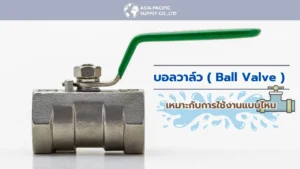
Ball Valve: What are the suitable applications for this type of valve?
In industrial piping systems, valves are essential devices that help control the direction, flow rate, and pressure of fluids. Each type of valve is designed to support different operations, especially the Ball Valve orball valve which is widely popular in both industrial and general utility systems.
Ball Valves feature rapid operation, tight shut-off, and low pressure drop, making them suitable for applications requiring precise opening–closing.
– What is a Ball Valve?
Ball Valves are valves that control fluid flow using a ball (Ball) with a hole through the center. To open the valve, the ball rotates so the hole aligns with the pipe, allowing fluid to pass freely. However, when rotated 90 degrees, the hole closes the fluid path, stopping the flow immediately.
This mechanism allows Ball Valves to open–close quickly and ensures a tight shut-off with no fluid leakage.
Key Advantages of Ball Valves
Common Types of Ball Valves
Ball valves can be divided into several types based on application. Generally, there are 4 main types:
1. Floating Ball Valve
In this type of ball valve, the ball is held in place by two seals. It is suitable for systems with moderate pressure, general water systems, and clean fluids.
2. Trunnion Mounted Ball Valve
A Ball Valve where the ball is fixed to both top and bottom stems for increased stability. It is high-pressure resistant and suitable for the energy and petrochemical industries.
3. Full Port Ball Valve
A ball valve where the bore size is equal to the pipe size, allowing full flow without pressure loss. Suitable for systems requiring maximum flow efficiency.
4. Reduced Port Ball Valve
A ball valve with a bore size slightly smaller than the pipe. Suitable for general applications where full flow is not required.
– Suitable Applications for Ball Valves
Despite having many subtypes, Ball Valves are generally popular for flow control in the following areas:
1. Water and Utility Systems
Ball Valves are ideal for water systems requiring frequent opening–closing, such as tap water, drainage, or sprinkler systems, because they operate quickly and do not cause pressure drops.
2. Oil and Gas Systems
Due to their tight shut-off capability, Ball Valves are suitable for systems requiring high safety, such as natural gas transmission, oil, and factory fuels.
3. Chemical and Energy Industries
In production processes involving corrosive fluids or high pressure, such as oil refineries, power plants, or chemical factories, stainless steel Ball Valves are commonly used for their excellent corrosion and high-temperature resistance.
4. Automation Systems
Ball Valves can be installed with Actuators for automated flow control. This is suitable for systems requiring precision and remote control, such as automated factory systems or production lines.
5. Applications Requiring Easy Maintenance
Since Ball Valves have few parts and are easy to replace, they are suitable for tasks requiring regular inspection and maintenance, such as HVAC systems or factory circulation piping.
Limitations of Ball Valves to Consider
Ball Valves are industrial valves that meet diverse needs with their speed, tightness, and durability. They are ideal for systems requiring precise opening–closing and high safety, such as oil, gas, chemical, or automated systems.
Choosing the right Ball Valve should be based on fluid type, pressure, temperature, and valve material to ensure long-lasting and efficient use. For further advice on selecting the right valve, you can contact the experts at Asia Pacific Supply & Engineering for a consultation to find the product that best fits your industrial application.