
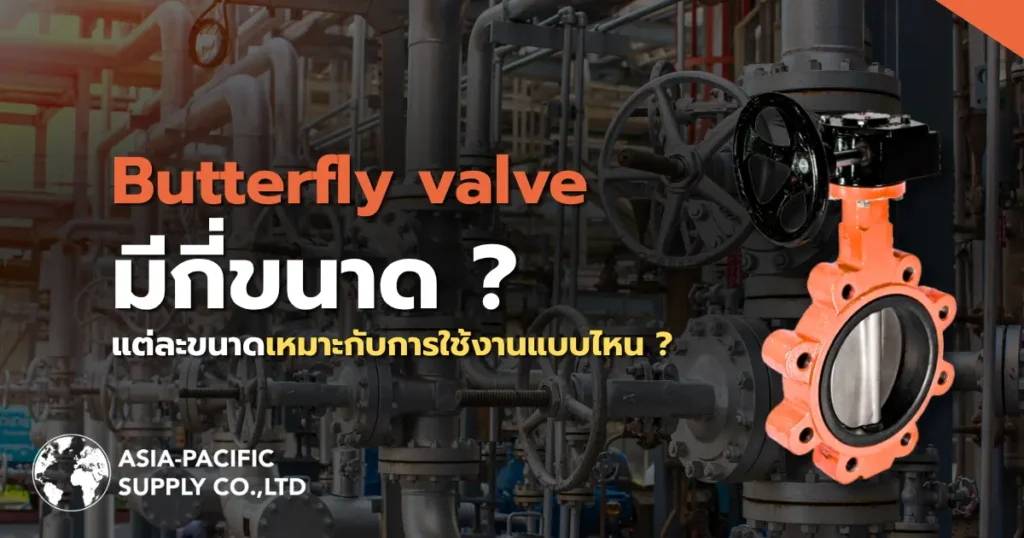
Butterfly valves are widely used in piping systems for both residential buildings and industrial plants. Due to their compact structure, quick opening and closing capabilities, and wide range of available sizes, they can be applied to everything from general water systems to large-scale industrial piping.
But how many sizes do Butterfly Valves come in, and how do you choose the right one for your system? Selection is not based solely on the pipe diameter; it must also take into account flow rate, pressure, temperature, and the type of fluid involved.
What is a Butterfly Valve?
A Butterfly Valve is a valve that controls flow using a disc mounted inside the valve body. When the valve stem is turned, the disc rotates to open, close, or regulate the flow of fluid. A rotation of approximately 90 degrees can move the valve from the fully closed to the fully open position.
With its quarter-turn operation, the Butterfly Valve opens and closes quickly. Furthermore, its structure is compact compared to other valve types, making it popular for systems with medium to large-sized pipes.
How Many Butterfly Valve Sizes Are Available?
Butterfly Valves are available in a wide range of sizes, typically from 2 inches (DN50) to over 48 inches (DN1200). Some manufacturers can produce even larger valves for specialized applications.
Therefore, there is no fixed number of sizes for Butterfly Valves, as the range depends on standards, valve designs, and individual manufacturers. However, common sizes found in general system applications include:
| Butterfly Valve Size | Approximate DN Size | Application Examples |
| 2–4 inches | DN50–DN100 | Water piping and utility systems |
| 5–8 inches | DN125–DN200 | HVAC systems and building water systems |
| 10–16 inches | DN250–DN400 | Water systems and industrial applications |
| 18–24 inches | DN450–DN600 | High-volume water transmission and distribution |
| Over 24 inches | Over DN600 | Large-scale piping and infrastructure projects |
This table provides general ranges for visualization purposes. Actual size selection should be based primarily on system design and engineering data.
What Applications Are 2–4 Inch Butterfly Valves Suitable For?
Small Butterfly Valves, approximately 2–4 inches, are suitable for piping systems with moderate flow rates, such as general water systems, utility lines, or branch pipes for equipment within buildings and factories.
The advantages include a compact size that requires minimal installation space. They can be either lever-operated or connected to an actuator, depending on the system’s control requirements.
What Applications Are 5–8 Inch Butterfly Valves Suitable For?
The 5–8 inch range is commonly found in building systems and various industrial applications, particularly HVAC systems such as chilled water and cooling water, as well as process water systems.
Valves in this size range can serve as isolation valves to open or close flow in specific zones. They may be used with a gear operator or an actuator to facilitate easier operation.
What Applications Are 10–16 Inch Butterfly Valves Suitable For?
As system flow rates increase and larger pipes are used—such as in factory water systems, cooling water systems, or central water distribution—10–16 inch Butterfly Valves are often utilized.
Butterfly Valves offer an advantage in these applications due to their relatively compact size and lower weight compared to other valve types of the same Nominal Pipe Size, thereby reducing the space required for installation.
What Applications Are 18–24 Inch Butterfly Valves Suitable For?
Butterfly Valves in the 18–24 inch range are suitable for systems that handle large volumes of water, such as distribution systems, large-scale cooling water systems, or main piping headers for large factories and buildings.
Valves of this size typically use gear operators or actuators for control, as manual operation may require higher torque due to the valve size and operating conditions.
What Are Butterfly Valves Larger Than 24 Inches Used For?
Butterfly Valves larger than 24 inches are found in massive piping systems, such as water production and transmission, industrial cooling water systems, public utilities, and infrastructure projects that manage high fluid volumes.
For this group of valves, careful consideration must be given to pressure ratings, actuators, torque requirements, installation space, and maintenance, as the size and operating conditions of the system directly impact valve selection.
Choosing the Right Butterfly Valve for Efficient Flow Control
Butterfly Valves are available from small sizes for general piping to large sizes for water systems and industrial work, allowing for versatile selection based on system characteristics. However, a larger valve size does not always mean it is more suitable or can handle higher pressure, as valve size and pressure rating are separate factors that must be considered together.
Selecting a Butterfly Valve should therefore involve considering pipe size, flow rate, pressure, temperature, fluid type, valve material, connection type, and control method in relation to the system design. Choosing the appropriate size and specifications ensures the valve controls flow as intended, reduces operational issues, and ensures long-term piping system efficiency.
If you are looking for high-quality Butterfly Valves from leading brands, contact the expert team at Asia Pacific Supply & Engineering. With over 29 years of experience, we are ready to provide consultation and offer products that meet all your industrial application needs.